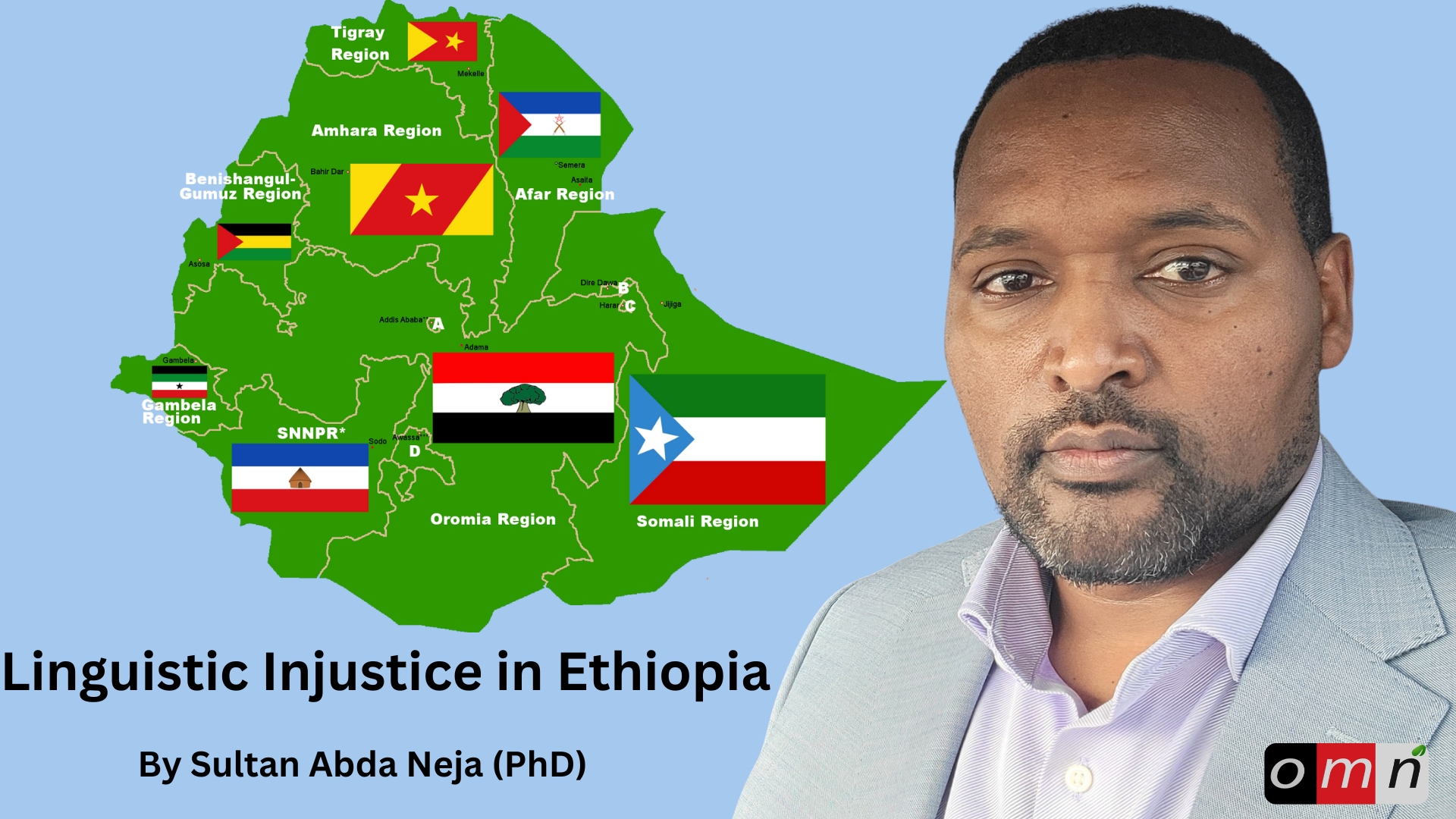
By Sultan Abda Neja (PhD)
Abstract: Despite being the most widely spoken language in Ethiopia, Afan Oromo remains
excluded from federal status, a deliberate political decision reinforced by the Abiy Ahmed-led
Prosperity Party (PP) and its education policy architect, Dr. Birhanu Nega. This article examines
how educational reforms and language policies systematically suppress the development of Afan
Oromo while privileging Amharic as the sole federal working language. It explores the legal,
historical, and policy frameworks that contribute to this injustice, offering evidence of
discrimination and its implications for national unity, democratic inclusion, and linguistic equity.
Introduction: Ethiopia is a nation of immense linguistic diversity, home to over 80 languages
and nationalities. Yet, paradoxically, its federal institutions operate almost exclusively in one
language: Amharic. This linguistic centralization persists even though Afan Oromo is the native
language of over 60% of the population, making it the most spoken language in the country.
While the Ethiopian constitution acknowledges the rights of nations and nationalities to develop
their languages, these promises remain unfulfilled. Instead, a unilingual federal language policy
has been preserved and deepened under the Prosperity Party (PP), led by Prime Minister Abiy
Ahmed.
The Myth of Language Equality in Education Policy: After Dr. Birhanu Nega assumed office
as Minister of Education, the Ethiopian education system underwent significant restructuring.
Under the guise of curriculum harmonization, the federal government:
- Removed Afan Oromo from national matriculation exams.
- Limited native-language instruction to Grade 6.
- Introduced policies that treat Amharic as the only legally sanctioned second language in
schools across the country (According to MoE policy enforcement letter in 2015 E.C).
Although previously Afan Oromo was used in public education and included in national
assessments, these reforms reversed such progress. Official explanations claimed that learning
science in Afan Oromo before transitioning to English in Grade 9 created academic difficulties.
However, research by UNESCO (2003) confirms that learning in ones mother tongue improves
comprehension and academic performance. Countries like Turkey, Iran, Japan, China, and Russia
educate students in their native languages up to university level and beyond. As Asafa Jalata
(2007) argues in the Journal of Oromo Studies, language suppression in Ethiopia is not merely
educational but political, aimed at maintaining hegemony through the control of linguistic
capital. This continues today under the guise of “harmonization.”
Legal Frameworks that Privilege Amharic: The education policy mandates that students must
learn a second language from among the federal working languages. But at present, Amharic is
the only recognized federal working language. This creates a de facto requirement for all
students, especially in Oromia, to learn Amharic, while no reciprocal obligation exists for
Amharic speakers to learn Afan Oromo.
Such policies effectively:
- Institutionalize linguistic inequality.
- Deny Afan Oromo equal development opportunities.
- Reinforce Amharic linguistic supremacy across federal and regional institutions.
These practices contradict the Federal Democratic Republic of Ethiopia (FDRE)
Constitution, particularly:
- Article 5(3): Members of the Federation shall have the right to determine their
respective working languages. - Article 39(2): Every Nation, Nationality and People in Ethiopia has the right to develop
its language, culture, and history.
Yet Afan Oromo, despite being the working language of Oromia, is sidelined in all federal
applications.
Curricular Censorship and the Erasure of Oromo Identity: The reforms went beyond
language exclusion. Educational materials underwent ideological revision:
- Symbols of Oromo identity such as the Oromia flag and Odaa tree were removed from
textbooks. - Oromo-centric content in history, geography, and social studies was purged.
- High school Afan Oromo instruction was reduced to once a week.
This curricular restructuring is not a neutral bureaucratic move; it is a political act designed to:
- Weaken Oromo national consciousness.
- Undermine the Qubee generation’s awareness of their cultural and political identity.
- Ensure future generations are disconnected from the struggle for linguistic and political
rights.
According to Gemechu Megersa, Ethiopian education policy and strategies often align with past
assimilationist models where curricula were tools of state ideology, designed to suppress non-
Amhara narratives and languages.
A Return to Imperial Linguistic Policy: Ethiopia’s current language policy mirrors those of the
Haile Selassie and Derg regimes, where Amharic was imposed as the sole language of
governance, education, and public life. The Prosperity Party, despite claiming to represent a new
political era, has continued this tradition. Amharic’s dominance is not a result of neutrality or
practicality but of decades of structural privilege and legal enforcement.
Even as the PP manifesto and pre-election propaganda outlets claim to recognize multiple
working languages, in practice, parliamentary debates, official documents, and ministerial
communication are still exclusively conducted in Amharic. This renders Afan Oromo, and by
extension, the Oromo people, invisible in the federal sphere.
Policy Implications and the Need for Reform: Without federal recognition, Afan Oromo’s
development will remain constrained. The lack of official federal use limits its utility, reduces its
perceived value, and discourages its academic, scientific, and bureaucratic expansion.
To reverse this injustice, Ethiopia must:
- Officially designate Afan Oromo as a second federal working language.
- Restore and expand Afan Oromo’s role in national examinations, high school and higher
education curricula. - Ensure reciprocal language learning policies that respect all linguistic communities.
As political blogger Biyya Oromoo (2023) noted, “One cannot build a federation of equals by
forcing one language on all and denying the other equal status.” The push for Afan Oromo as a
federal language is not about replacing Amharic, it’s about achieving balance and equity.
Conclusion: Language is not only a tool for communication, but also a vessel of identity, culture,
and political agency. An oromo legend and Artist Ali Birra says in his song “Afaan Oromoo,
Hundee Oromummaa” reflecting the deep rooted role of Afan Oromo for Oromo identity and
existence. Denying Afan Oromo its rightful place as a federal working language perpetuates
colonial-era hierarchies and weakens Ethiopia’s democratic project.
The systematic suppression of Afan Oromo under the Prosperity Party and its Ministry of Education is a political choice, not an administrative necessity. Addressing this linguistic injustice is essential not only for Oromo dignity but also for the nation’s unity and future.
References:
- UNESCO (2003). Education in a Multilingual World. Paris: UNESCO.
- FDRE Constitution (1995). Articles 5 and 39.
- Ministry of Education, Ethiopia (2023). Education Harmonization Guideline.
- Global Language Justice Index (2022).
- Ethiopia Central Statistics Agency (2018). Population and Language Use Survey.
- Jalata, Asafa (2007). The Politics of Language and Cultural Domination in Ethiopia.
Journal of Oromo Studies, Vol. 14, No. 2. - Megersa, Gemechu (2021). Curriculum Reform and the Oromo Question in Ethiopia.
Journal of Oromo Studies, Vol. 28, No. 1. - Biyya Oromoo (2023). “Linguistic Equality and the Federal Illusion.” Oromo Digital
Forum.
Author Bio:
Dr. Sultan Abda Neja is a multidisciplinary scholar with a Doctorate in Biochemistry from the National University of Singapore and advanced degrees in Microbiology and Biotechnology. He has served as Assistant Professor at Wollega and Hawassa Universities in Ethiopia, where he actively participated in curriculum development, educational reform, and academic mentorship. With over a decade of combined research and teaching experience in Ethiopia’s higher education sector, Dr. Neja has a deep understanding of education policy and its socio-political implications. His scholarly advocacy against systemic exclusion of Afan Oromo from the federal framework, Dr. Neja continues to engage with issues of equity, identity, and policy justice in Ethiopia.