Finfinnee and the contested historiography of the Ethiopian state: subaltern Oromo identity, language and the failed attempts of socio-political erasure
Finfinnee and the contested historiography of the Ethiopian state: subaltern Oromo identity, language and the failed attempts of socio-political erasure
Book Review
Finfinnee and the contested historiography of the Ethiopian state: subaltern Oromo identity, language and the failed attempts of socio-political erasure
Habtamu Abino [LLB, MBA], Girma Gutema [PhD]
About the book:
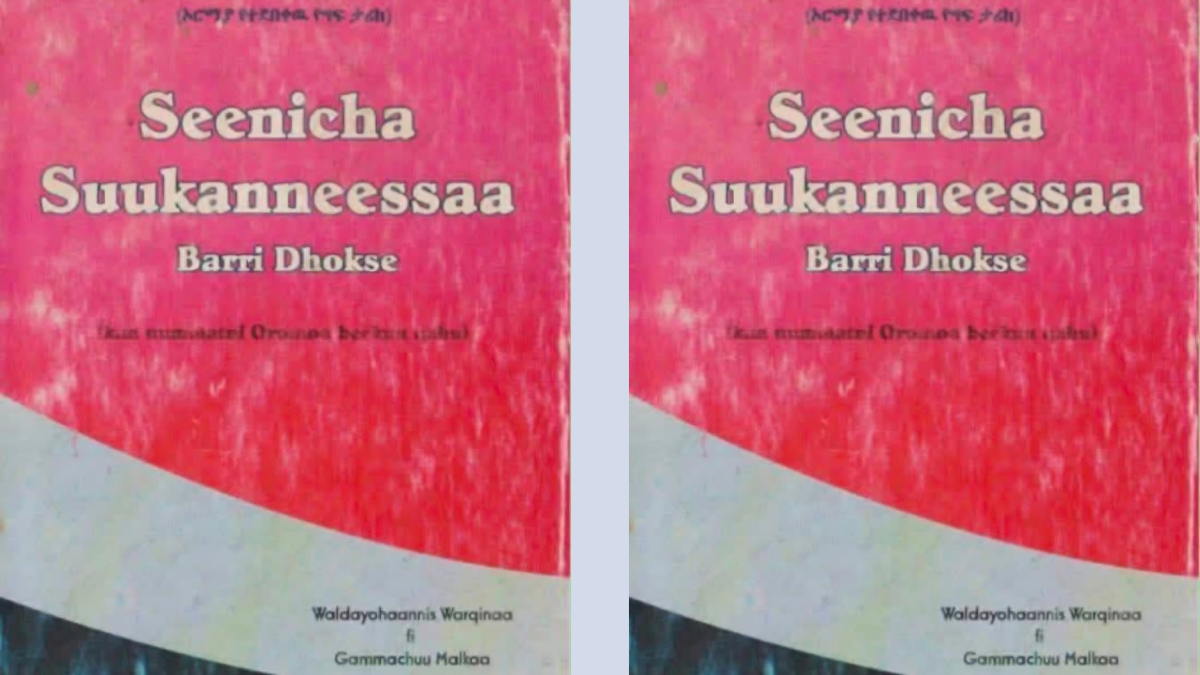
Title of the book: Seenicha Suukanneessaa Barri Dhokse [Afaan Oromoo]
Authors: Woldeyohannes Workineh & Gammachu Malkaa (Published in Finfinne, Oromia, Ethiopia). The book has 10 chapters with total pages 286, including references section.
The publication of Seenicha Suukanneessaa Barri Dhokse), co-authored by Waldayohaannis Warqinaa and Gammachuu Malkaa, represents a critical milestone in modern Oromo historiography. Operating as a systematic counter-narrative to the state-sanctioned historical orthodoxy of the Ethiopian empire, the text seeks to expose the structural violence, territorial expropriation, and cultural erasure that accompanied the consolidation of the modern Ethiopian state. By analysing the mechanisms through which the northern Abyssinian ruling class expanded southward, the authors deconstruct the myth of voluntary national unification and replace it with a rigorous critique of internal colonialism, military conquest, and structural subjugation.
Counter-Narratives and the Epistemology of Ethiopian Statehood
At the core of the book’s opening argument is a philosophical reflection on the nature of freedom and memory. Invoking Thomas Jefferson’s famous axiom that the God who gave humanity life also gave them liberty, the authors argue that freedom is an inherent divine endowment, whereas oppression, subjugation, and systemic cruelty are manifestations of structural evil. The book challenges the psychological mechanisms of imperial hegemony, noting that ruling elites have historically glorified their conquests as civilizing missions. This historical revisionism has left a profound impact on the collective consciousness of the Ethiopian state, where historical errors and systemic injustices are often repackaged and celebrated as patriotic achievements.
To contextualize the psychological impact of this historiographical suppression, the authors employ a traditional Oromo proverb: “the one who stabs forgets, but the one who is stabbed does not”. In the contemporary political landscape, however, the authors argue that this dynamic has been pathologically inverted: the descendants of the perpetrators have romanticized the imperial past, while the descendants of the victims are systematically pressured to forget their historic grievances. The text draws a parallel to international struggles, translating a European poem regarding ethnic conflicts in the Balkans and Eastern Europe to illustrate that when national pride is constructed on the hatred, subjugation, or displacement of neighbouring ethnonational groups, it ceases to be a healthy patriotism and instead becomes a destructive ideology.
This conceptual framework is used to analyze modern political groupings, such as the MAHD (All-Amhara People’s Organization), which the authors argue utilized the rhetoric of “national unity” to preserve historic Amhara hegemony while suppressing the legitimate demands of the Oromo and other southern nations for self-determination. The book asserts that genuine national unity cannot be forged by suppressing historical truths, maintaining unequal rights and relations, or forcing diverse populations to adopt the identity of a single ruling class.
Linguistic Hegemony, Dehumanization, and the Weaponization of Orthodoxy
A primary method of imperial consolidation was the systematic dehumanization of the Oromo people through language and state-sponsored literature. The authors trace how northern chroniclers, such as Alaqaa Taayyee, fabricated migration myths that portrayed the Oromo as rootless, foreign invaders who supposedly originated from Asia, traversed Madagascar, and entered the Horn of Africa via the waters of the Ganale River. This pseudo-historical narrative was designed to strip the Oromo of their indigenous status and justify their violent dispossession. The pejorative term “Galla”—a label rejected by the Oromo—was institutionalized in state, religious, and academic texts to signify paganism (aramanee), barbarism, and subhuman status, thereby rendering the conquest and enslavement of the Oromo morally permissible to the conquering elites.
This dehumanizing discourse was deeply embedded within the religious literature of the Ethiopian Orthodox Tewahedo Church. The authors cite the Taammira Maariyaam (“Miracles of Mary”), a highly revered religious text republished as late as 1960, which explicitly grouped the Oromo (“Galla”) and the Nilotic populations (“Shaanqillaa”) alongside Muslims, heretics, and those engaging in bestiality. The text condemned these groups to a five-thousand-year spiritual abyss, establishing a powerful ideological justification for their physical abuse and social exclusion.
Through such theological framing, the Orthodox Church functioned as an arm of the state, teaching that Amhara identity was synonymous with Christian purity and civilizational leadership, while non-Amhara populations were inherently inferior and required paternalistic subjugation. The state subsequently leveraged this cultural hierarchy to implement exclusionary policies; for example, the authors highlight documented instructions from state manuals, such as the Bemaaleedaa magazine of 1985, which dictated that police and security forces must be recruited exclusively from Amhara, Christian, and Amharic-literate populations to ensure the security of the ruling class.
Geopolitical Cartography: European Firearms and Imperial Resettlement
The physical expansion of the Abyssinian empire into Oromia and the wider south was fundamentally enabled by a symbiotic relationship with European imperial powers. During the late 19th century “Scramble for Africa,” northern rulers systematically leveraged their Christian identity to secure advanced European weaponry. The Shewan king Saahila Sillaase initiated this pattern in the 1840s by securing British and French firearms under the pretext of expanding Christian territories southward. Equipped with these modern weapons, Saahila Sillaase launched devastating military expeditions against the Tuulama Oromo, conducting dozens of raids that resulted in massive civilian casualties, the looting of tens of thousands of cattle, and the capture of Oromo children and women for domestic slavery.
Following military conquest, the imperial state consolidated its grip through the Neftenya (armed settler) system. The authors reveal archived state guidelines demonstrating that the resettlement of northern populations into the conquered south was systematically planned and funded by the state. While the indigenous Oromo were evicted from their fertile lands and forced into serfdom, the imperial administration provided northern settlers with comprehensive support, including:
- Exemption from agricultural taxes on newly acquired lands.
- State-backed development loans through the agricultural and development banks.
- Free agricultural inputs, high-yield seeds, and modern farming equipment.
- Free veterinary care for their livestock and targeted agricultural training from state extension officers.
This unequal state support guaranteed that the settler population rapidly acquired dominant economic power, transforming them into wealthy landowners, urban developers, and state administrators, while the indigenous populations were starved of basic infrastructure, clean water, schools, and medical facilities.
Territorial Conquest and Wars of Resistance
The southern expansion was met with fierce, sustained resistance from various Oromo groups and southern kingdoms. The authors document that this resistance was only broken through superior firepower and calculated strategies of division. Abyssinian commanders actively exploited internal rivalries, utilizing the “divide and conquer” strategy to turn neighbouring clans against one another. A prime example of this was the manipulation of local conflicts in Shewa, where the imperial state fuelled animosity between the Abichu and Galaan Oromo, eventually aligning with the weakened party to crush both and force them to pay heavy tribute.
The inter-Abyssinian rivalry for the resources of the south also led to direct conflicts, such as the Battle of Imbabo in 1882, where King Tekle Haymanot of Gojjam and King Menelik of Shewa fought to determine which northern kingdom would secure the sole right to colonize and exploit the wealthy Oromo territories of Horroo Guduru, Wallagga, and Kafa. Once Shewan dominance was established, the conquest proceeded with extreme violence.
The Battle of Calanqoo in 1887 saw the destruction of Harar’s defensive forces, securing Menelik’s control over the eastern trade routes. In the south, the Arsi Oromo waged a legendary six-year war of resistance (1881-1887) against the massive, modernly equipped armies of Ras Darge—Menelik’s uncle and one of his top army commanders. The resistance was finally broken through horrific acts of state terror, most notably the Anolee massacre, where imperial forces gathered surrendered Arsi fighters and civilians under the guise of peace negotiations, only to systematically amputate the right breasts of Oromo women and the right hands of men.
Similarly, the Wolayta kingdom under King Toona was crushed in 1894 during a bloody campaign where tens o thousands of defenders were slaughtered, their towns burned, and the survivors subjected to mass enslavement and humiliation.
Oromia’s Ecological Wealth and Resource Extraction
The book dedicates significant analysis to the geography, ecology, and natural resources of Oromia, demonstrating that the primary driver of the northern conquest was the extraction of this immense wealth. The authors describe Oromia as a land of diverse topography, dominated by massive mountain ranges and abundant water systems. To display this structured geographical data, the mountain heights of Oromia are detailed below:
Table 1: Major mountains in various regions of Oromia and their altitudes
| Mountain Name | Region / Zone | Altitude (Meters) |
| Kaarraa | Arsi | 4,340 |
| Baatuu | Bale | 4,307 |
| Angalloo | Arsi | 4,300 |
| Mul’ataa | Hararghe | 3,392 |
| Baddaa Roggee | Shewa | 3,350 |
Oromia is also characterized by a highly productive and varied ecosystem, which the authors organize into distinct ecological zones. These zones are structured as follows:
Table 2: Regional distribution of Oromia’s ecological zones, key soil types, rainfall ranges and agricultural outputs
| Ecological Zone | Included Regions / Territories | Key Soil Types | Altitude & Rainfall Range | Primary Commodities / Agricultural Output |
| Central Highlands | Shewa, parts of Wallo and Wallagga | Infisol and Vertisol | 1,800-3,000m; 950-1,500mm | Grains, oilseeds, cash crops for urban markets |
| South & West | Wallagga, Iluu Abbaa Boora, Jimmaa | Oxisol and Antisol | 1,500-2,400m; High rainfall | Coffee, maize, root crops, ginger |
| South East | SE Shewa, West Sidama | Volcanic / Gabbroic | >1,500m; >950mm | Barley, potatoes, anchote, various tubers |
| East Highlands | Bale, Arsi, Hararghe | Well-drained loam | >1,800m; 950-1,500mm | Wheat, barley, high-altitude coffee, khat |
| Borana Lowlands | Borana, South Bale | Arid / Sandy loam | <900m; 450-900mm | Pastoralism, beef cattle for state export |
This ecological diversity facilitated the production of high-value agricultural assets, such as coffee and tea, which became the financial backbone of the modern Ethiopian state. In 1976 alone, Oromia produced 1.8 million quintals of coffee, utilizing over 500,000 hectares of land.
The authors point out that while 98.7% of this land was cultivated by impoverished local peasants, the state and the Derg military junta systematically extracted the profits to fund weapon purchases. Similarly, tea plantations in Shaawushaawuu (500 hectares) and Gumaaroo (390 hectares) produced thousands of quintals of tea for export, while local communities remained impoverished.
Beyond agriculture, Oromia’s extensive river systems—including all the major tributaries of the Blue Nile, Awash, Ganale, Wabe, Dhidheessa, Gibe, and Baro—were heavily exploited for electricity and industrial irrigation, serving regions outside of Oromia while local residents lacked basic electricity access. The territory’s mineral wealth was also systematically plundered. The authors present detailed data compiled from geological surveys showing the vast metallic and non-metallic mineral reserves of Oromia. In addition to metallic minerals, Oromia’s industrial non-metallic deposits are highly extensive.
Table 3: Regional Distribution of non-metallic minerals and estimated reserves in Oromia
| Gosa Albuudaa (Non-Metallic Mineral Type) | Location / Deposit Site | Estimated Reserves (Tons) |
| Clay / Pipe Minerals | Various Deposits | 500,000 |
| Qanxiichaa Feldspar | Guji / Borana | 300,000 |
| Soda Ash | Lake Abiyata | 400,000,000 |
| Diatomite | Rift Valley Lakes | 40,000,000 |
| Coal / Lignite | Various Basins | 50,000,000 |
| Mugar Limestone | Ada’a/Meta Mugar Valley | 100,000,000 |
| Dire Dawa Limestone | Dire Dawa | 46,000,000 |
| Mugar Silica Sand | Ada’a/Meta Mugar Valley | 3,400,000 |
| Hula Qunii Dolomite | West Hararghe | 1,434,000 |
Human Commodification: Enslavement, Castration, and the Swedish Missionaries
The economic expansion of the empire was heavily reliant on the capture and trade of human beings. The book provides a detailed analysis of the active involvement of the Abyssinian ruling class, including Emperor Menelik and Empress Taytu, in the highly lucrative slave trade. The authors document that the imperial court personally owned over 70,000 domestic slaves, and the state collected a systematic 10% tax on all slave transactions conducted by regional governors. Abyssinian officials, such as Qanyaazmaach Abuubakar, built immense personal fortunes by hunting and exporting thousands of Oromo, Sidama, and Nilotic children and young adults to the Middle East and neighbouring territories annually.
To capture the profound personal tragedy of this trade, the authors record the first-hand testimony of an elderly Oromo man named “Jimma”. Kidnapped as a child by Shewan soldiers during a raid on his family’s homestead, his father was brutally beaten with rifle butts when he attempted to intervene, and their cattle were looted. Jimma was marched in chains to Shewa, where his captor performed a surgical castration (kolaasuu) to ensure he could never reproduce or establish a family line. He spent his entire life in forced servitude, marginalized and physically altered, representing the absolute disregard for human dignity that characterized the imperial conquest.
Amidst this widespread human commodification, the book highlights the rescue efforts of Swedish Protestant missionaries operating along the Red Sea coast at Massawa. These missionaries purchased or intercepted slave caravans, liberating numerous young Oromos.
Among those rescued was Onesimos Nesib (originally named Hiikaa), who was freed from Abyssinian slave traders, educated by the Swedish mission, and eventually collaborated with another freed Oromo scholar, Aster Gannoo, to translate the Bible into Afaan Oromoo. In 1894, Onesimos published The Galla Spelling Book (Jalqaba Barsiisaa) at the Swedish mission press in Geleb, laying the groundwork for modern written Afaan Oromoo and preserving the language against state-mandated eradication. Other notable Oromo individuals rescued by the Swedish mission included Feeben Hirphee and Liidiyyaa Diimboo, who went on to contribute significantly to the preservation of Oromo literature and social history.
The Pluralist Interregnum: The Rise and Tragic Fall of Lij Iyasu
A critical turning point in the history of the empire occurred during the short-lived reign of Lij Iyasu (1913 – 1916), the grandson and designated heir of Emperor Menelik II. Unlike his predecessor, Iyasu possessed Oromo ancestry through his father, Ras Mikael of Wallo, and sought to reform the empire’s rigid, exclusionary ethno-religious hierarchy.
Iyasu envisioned a pluralistic state where Muslims and Christians enjoyed equal rights under the law. He travelled extensively throughout the southern provinces, actively integrating Oromo and Muslim elites into state administration, constructing mosques alongside Orthodox churches, and proposing a modified national flag that incorporated Islamic symbols alongside Christian ones to reflect the country’s diverse demographics.
Iyasu’s progressive reforms represented an existential threat to the Shewan Amhara ruling class and the Orthodox clergy, who were determined to protect their historic privileges. In 1916, Shewan aristocrats, led by Fitaworaarii Habtagoorgis and supported by European colonial powers (Britain, France, and Italy), staged a coup d’état. Iyasu was excommunicated by the head of the church, the Abuunaa, on fabricated charges of apostasy and secretly converting to Islam.
After years of evading capture and launching a failed counter-offensive with his father’s Wallo army, Iyasu was captured and placed under high-security house arrest. He was held in isolated locations, including Kurfa Callee in Hararghe, Mount Mulata, and eventually the villa of Ras Gobana Gooshuu. The authors reveal that Iyasu was eventually executed with a London knife on the direct orders of Emperor Haile Selassie to prevent him from becoming a rallying figurehead for Oromo and Muslim resistance. To cover up the execution and prevent an uprising from Iyasu’s loyalists, the emperor ordered his personal physician, Dr. Anaar, to sew the deep neck wound back up, presenting the corpse to the public as a natural death caused by illness.
Haile Selassie’s Autocracy and the Geopolitics of Western Patronage
Following the elimination of Lij Iyasu, Ras Tafari Makonnen ascended the throne as Emperor Haile Selassie I, initiating a period of highly centralized autocracy. While the emperor projected a progressive image to the international community, the authors argue that his internal policies systematically consolidated the Neftenya feudal system. Under his revised 1955 constitution, the dispossession of southern peasants was legally codified; any southern peasant who attempted to reclaim ancestral land was labelled an outlaw, evicted, and prosecuted under state property laws.
To enforce this centralized hegemony, Haile Selassie enacted strict cultural assimilation policies. On October 24, 1948, the imperial administration issued a language decree declaring Amharic as the sole official language of administration and primary education throughout the empire, effectively outlawing Afaan Oromoo in public spaces, courts, and schools. To sustain this feudal structure against growing peasant rebellions, Haile Selassie relied heavily on Western geopolitical patronage, particularly from the United States. In 1953, the United States signed a Mutual Defense Treaty with Ethiopia, securing the Kagnew communication and spy station in Asmara, Eritrea. In exchange, the United States provided massive economic and military aid to the imperial regime:
- Total Economic Development Funding: Over 350 million dollars.
- Total Direct Military Aid & Armaments: Over 270 million dollars.
This foreign military assistance provided the imperial state with modern tanks, fighter jets, and automatic weapons, which were deployed to suppress peasant uprisings, such as the Bale peasant rebellion and the Tigray peasant revolt, maintaining the feudal subjugation of the southern populations through external force.
The Structural Collapse of the Imperial Hegemony
The authors conclude their historical analysis by examining the final years and eventual collapse of the imperial regime, a process they describe as the “heart attack of the Neftenya government”. By the early 1970s, the contradictions of the centralized feudal system had become unsustainable. The aging emperor, who was over eighty years old, refused to delegate power or name a capable successor, paralyzing the state’s decision-making apparatus.
The ultimate crisis was triggered by the catastrophic Wallo Famine of 1972 – 1974, which resulted in the starvation of over 200,000 peasants. To maintain its international prestige, the imperial government systematically concealed the famine from the international community and continued to export grain from the affected regions. When the scale of the famine was exposed by international journalists, it sparked outrage among students, labor unions, and military officers. The regime’s legitimacy collapsed entirely.
This systemic failure, coupled with hyperinflation and the complete political paralysis of the ruling class, culminated in the 1974 revolution. The Coordinating Committee of the Armed Forces, known as the Derg, seized power and abolished the monarchy, ending centuries of imperial rule, but paving the way for a new era of extremely militarized state control.
Conclusions and Structural Legacy
The historical analysis in Seenicha Suukanneessaa Barri Dhokse demonstrates that the modern state of Ethiopia was constructed on military conquest, systematic land dispossession, and cultural imperialism. The authors show that the structural inequalities of the late 19th century conquests were not temporary historical events, but the foundational pillars of the Ethiopian state.
The transition from imperial rule did not dismantle these deep-seated colonial hierarchies. The legacy of the Neftenya land-tenure system, the suppression of indigenous governance systems like Gadaa, and the institutionalized marginalization of the Oromo language continue to shape contemporary conflicts in the Horn of Africa. The authors conclude that a peaceful and democratic future for the region can only be achieved by fully acknowledging these historical injustices, restoring the historical rights of dispossessed populations, and building a political order based on genuine self-determination and equal national representation.