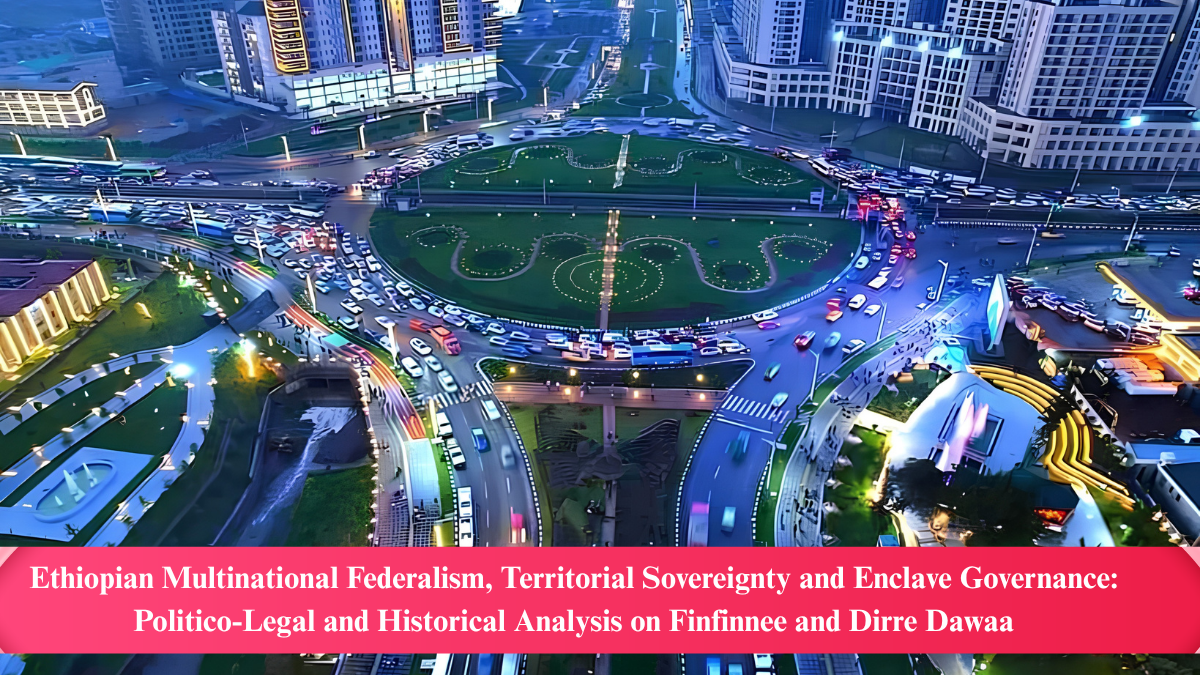
Ethiopian Multinational Federalism, Territorial Sovereignty and Enclave Governance: Politico-Legal and Historical Analysis on Finfinnee and Dirre Dawaa
Ethiopian Multinational Federalism, Territorial Sovereignty and Enclave Governance: Politico-Legal and Historical Analysis on Finfinnee and Dirre Dawaa
Habtamu Abino [LLB, MBA], Girma Gutema [PhD]
With an astonishingly audacious take that surprised many federalist political and rights groups alike, Finfinnee (Addis Ababa) and Dirre Dawa—municipal districts in Oromia’s territory, but administratively sliced out of it—are being presented ‘for sale’ on the so called “National Dialogue” drama underway in Ethiopia. This article dives deep into the issue and offers some important politico-legal and historical analyses on this developing story.
Conceptual Framework of Ethiopian Multinational Federalism
The 1995 Constitution of the Federal Democratic Republic of Ethiopia (FDRE) re-engineered the Ethiopian state from a historically centralized unitary structure into a multinational federation. Vested with sovereign authority under Article 8, the “Nations, Nationalities, and Peoples” of Ethiopia were granted unconditional rights to self-determination, self-governance, and ethno-territorial autonomy. The structural architecture of the federation was demarcated into ethnically defined member states pursuant to Articles 46 and 47. However, the spatial configuration of major urban metropolitan centers within this ethno-territorial matrix introduced acute constitutional, legal, and political frictions.
The most prominent manifestations of this structural tension are the dual federal enclave cities: Finfinnee (Addis Ababa) and Dire Dawa. Finfinnee, historically and geographically located at the heart of the Oromia Regional State, serves simultaneously as the capital of the federal state and the regional state of Oromia. Dire Dawa, situated along the eastern transit corridor, represents a historically contested borderland between the Oromia and Somali regional states.
The constitutional mechanisms designed to govern these urban centers—specifically Article 49 for Addis Ababa and federal charter proclamations for Dire Dawa—have created a legal paradox. By placing these cities under direct federal accountability (itti-waamama federaalaa), the constitutional order established autonomous federal enclaves within the territorial boundaries of constituent states. This arrangement directly conflicts with historical Oromo claims of spatial ownership (abbummaa), tests the limits of territorial integrity under federalism, and raises complex legal questions regarding resident self-governance versus host-state constitutional rights. Within the context of the ongoing National Dialogue process (maarii biyooleesaa), re-evaluating these enclave governance structures is essential for achieving a sustainable framework for peaceful coexistence (waliin jiraachuu) and constitutional stability.
The Legal Status of Finfinnee under Article 49 and the Evolution of Oromia’s Rights: Textual Construction and Internal Contradictions
Article 49 of the 1995 FDRE Constitution sets out the formal legal framework governing the capital city. Article 49(1) formally designates Addis Ababa as the capital city of the Federal government. Article 49(2) guarantees the residents of the city a “full measure of self-governance,” specifying that particulars shall be determined by law. Article 49(3) establishes that the Administration of Addis Ababa shall be directly responsible and accountable to the Federal Government. Article 49(4) mandates parliamentary representation for city residents in the House of Peoples’ Representatives. Finally, Article 49(5) explicitly mandates that the “special interest” (faayidaa addaa) of the State of Oromia in Addis Ababa—regarding social services, natural resource utilization, joint administrative matters, and related issues—shall be respected, with particulars to be determined by law.
A critical legal divergence exists within Article 49(2) between the official Amharic and English versions of the Constitution. The Amharic text—which is the legally binding authoritative version under Article 106—stipulates that self-governance is vested in the “City Administration” (የከተማው አስተዳደር), whereas the English translation grants self-government directly to the “residents”. Legal scholars observe that this discrepancy narrows the scope of political autonomy for city residents compared to the ethno-territorial nations, nationalities, and peoples governed under Article 39(3), who possess full rights to self-determination, statehood, and constitutional secession. Addis Ababa residents enjoy local administrative autonomy, but the city lacks sovereign partnership within the federation, possessing no representation in the upper legislative house—the House of Federation—which interprets the Constitution.
Furthermore, Article 49(3) creates an institutional subordination. By subjecting the municipal administration to the executive oversight of the Federal Government, it allowed the federal executive to exercise the ultimate veto power and political control over municipal appointments, budgeting, and spatial development policies, frequently placing federal priorities in direct opposition to local resident interests and regional state claims.
Historical Evolution and Legal Scope of Oromia’s “Special Interest”
The legal concept of Oromia’s “Special Interest” (faayidaa addaa) did not originate in the 1995 Constitution. It’s legal genealogy traces back to the transitional legal architecture. Following the collapse of the Derg regime in 1991, the Transitional Charter and subsequent Proclamation No. 7/1992 (which established national/regional self-governments) recognized Oromia as Region 4. Under Article 3(4) of Proclamation No. 7/1992, the law explicitly reserved both the special interest and political rights (mirga politikaa) of the Oromo nation over Region 13 (Harari) and Region 14 (Addis Ababa). This transitional legal provision recognized economic and social interests while explicitly acknowledging political rights over the city. However, during the drafting and ratification of the permanent 1995 FDRE Constitution, the term “political rights” was intentionally removed from Article 49(5), leaving only the phrase “special interest”. Jurisprudentially, Black’s Law Dictionary defines “interest” as a synergy of rights, powers, privileges, and immunities. Legal analysts argue that even without the explicit inclusion of the word “political,” any robust interpretation of “special interest” within a multinational federation geographically encompassing a capital city must entail co-governance powers and territorial rights, Article 49(5) outlines four core functional areas comprising this interest. First, in the provision of social services, it demands priority access for Oromo populations to educational, cultural, and health institutions operating within the city. Second, regarding natural resources, it requires shared authority and equitable compensation concerning groundwater extraction, waste disposal, and land use within and surrounding municipal boundaries. Third, in joint administrative matters, it mandates collaborative municipal planning, boundary demarcation, public safety, and infrastructure integration between the City Administration and the Oromia Regional State. Fourth, through residual “other similar matters,” it provides broad authority to protect the linguistic, cultural, and socio-economic presence of the Oromo nation within its historical urban center.
Despite the clear constitutional mandate under Article 49(5) stating that particulars shall be determined by law, the Ethiopian Federal Parliament failed to enact the required implementing legislation for over two decades. This legislative omission created a legal vacuum that enabled federal authorities to treat Finfinnee as an autonomous federal enclave completely detached from Oromia’s legal jurisdiction.
Table 1: Legal instruments, land and territorial jurisdiction and status of Oromia’s right over Finfinnee
| Legal Instrument /
Era |
Governance
Accountability |
Political Rights
Allocation |
Land & Territorial
Jurisdiction |
Status of Oromia’s
Rights |
| Transitional Charter & Proc. 7/1992 | Accountable to
Central Transitional Government |
Explicitly reserved Oromo political rights over Region
14 |
Enclave city surrounded by Region 4 (Oromia) | “Special interest and political rights”
explicitly recognized |
| 1995 FDRE
Constitution (Art. 49) |
Accountable directly to Federal Government (Art. 49(3)) | Resident self-governance
(Art. 49(2)); Parliamentary seats (Art. 49(4)) |
Federal Capital; legally detached from Oromia’s administrative map | “Special Interest” reserved under
Art. 49(5); “political rights” dropped |
| 2017 Draft
Proclamation on Special Interest |
Maintains Federal
oversight; proposes Joint Municipal-Regiona l Council |
Frames Oromo
rights primarily as individual cultural/linguistic protections |
Permitted continued municipal spatial expansion into Oromia Special
Zone |
Criticized as “special treatment” or “affirmation of denial” rather than ownership |
The Enclave Dilemma and Socio-Spatial Dispossession
The legal structure of Article 49 creates a spatial paradox characterized by political geographers and legal analysts as being “in Oromia, but not of Oromia”. Geographically, Finfinnee is situated entirely within the territorial boundaries of the Oromia Regional State. It serves as the official seat of the Oromia Regional Government, housing its administrative bureau structures alongside the federal government. Politically and administratively, however, it functions as an autonomous federal entity outside Oromia’s legal jurisdiction.
From the perspective of Oromo legal scholars and ethno-national groups, designating Finfinnee as directly accountable to the Federal Government (itti-waamama federaalaa) constitutes a structural disenfranchisement and a violation of Oromia’s territorial integrity. The historical argument posits that the city was established through imperial expansion and the forcible displacement of indigenous Oromo clans, including the Gulallee, Abichuu, and Ekka.
Consequently, treating federal accountability as absolute jurisdiction transforms the historical host community into an alien group within its own ancestral territory.
Furthermore, federal control over Finfinnee creates severe administrative asymmetry. Under Articles 50, 51, and 52 of the FDRE Constitution, the Federal Government possesses strictly enumerated powers, reserving non-enumerated residual powers to the Regional States. By exercising direct statutory control over a vast metropolitan territory deep within Oromia, federal authorities routinely encroach upon regional state jurisdiction over land administration, environmental regulation, and public infrastructure.
The lack of statutory clarification regarding Article 49(5) had severe material consequences for surrounding rural Oromo communities. Under Article 40(3) of the FDRE Constitution, land ownership is exclusively vested in the State and the Peoples of Ethiopia, granting the government broad powers of public land administration and eminent domain expropriation. Throughout the 2000s and 2010s, the Addis Ababa City Administration, backed by federal authority, engaged in aggressive urban expansion into the surrounding Special Zone of Oromia Surrounding Finfinnee. This horizontal expansion led to massive, inadequately compensated development-induced displacement of hundreds of thousands of Oromo farming households, transforming agrarian producers into landless urban day-laborers.
This socio-spatial dynamic reached a boiling point with the 2014 Integrated Development Master Plan (IDMP), which sought to expand Addis Ababa’s municipal planning jurisdiction over thirty surrounding Oromo towns and rural districts. Oromo civil society and political groups viewed the Master Plan as a legal mechanism for annexation and territorial dissection of Oromia. The resulting protest movement between 2014 and 2018 demonstrated that the failure to constitutionally reconcile federal enclave governance with regional state sovereignty posed an existential threat to the stability of the entire federation.
Critical Jurisprudential Analysis of the 2017 Draft Proclamation
In response to sustained public protests, the Council of Ministers drafted legislative proposals in mid-2017 to finally implement Article 49(5). However, a legal critique of the 2017 Draft Proclamation reveals that it failed to resolve the fundamental constitutional conflict. The draft bill re-defined “special interest” primarily as a bundle of individual cultural, linguistic, and educational privileges for Oromo residents living within Addis Ababa, such as establishing Afaan Oromoo schools, cultural centers, and language services. In doing so, it treated the Oromia Regional State as a passive recipient of federal concessions rather than a co-equal sovereign entity possessing territorial rights. Furthermore, the bill failed to fix the spatial boundary of Addis Ababa, allowing the city to retain expropriated lands and leaving open the legal avenue for future municipal expansion into Oromia’s jurisdiction. Finally, instead of establishing a co-equal joint administration council with legislative authority, the draft bill created an administrative consultative organ heavily dominated by federal executive appointees. Consequently, legal scholars characterized the draft proclamation as an “affirmation of denial”—a statutory exercise that codified federal dominance while granting symbolic cultural concessions to the host state.
Dire Dawa’s Jurisdictional Contestation, Ethnic Demographics and Constitutional Anomaly: Historical Genesis, Clan Identities, and Demographic Realities
Dire Dawa emerged as a major urban settlement following the construction of the Imperial Railway Company of Ethiopia (Franco-Ethiopian Railway) in 1902 under Emperor Menelik II. Constructed because steep terrain prevented the railway line from passing directly through the ancient city of Harar, Dire Dawa rapidly evolved into a vital commercial and transportation hub connecting inland Ethiopia to Djibouti. The city’s location along the lowlands positioned it at the intersection of complex ethno-linguistic, clan, and socio-cultural boundaries. The name itself reflects contested historical narratives, rendered as Dirree Dhawaa (“Place of Remedy”) in Afaan Oromoo, Diridhaba (“Where Dir hit his spear”) in Somali, and Dire Dawa in Amharic. Historically, the surrounding territory was inhabited by Oromo clans, principally eastern Oromo groups such as the Barentu and Afran Qallo, and Somali clans, principally the Dir/Issa and Sitti Somali groups.
Furthermore, the identity of the indigenous Gurgura community became a focal point of intense political contestation after 1991. While Oromo political actors classify the Gurgura as an Oromo clan branch based on linguistic and historical lineage, Somali political actors categorize them as a Somali clan, leading to competing territorial claims over rural woredas surrounding the city.
These local dynamics are deeply connected to broader eastern lowland territorial rivalries between the Oromia and Somali regional states. Territorial disputes along the extensive Oromia-Somali border—such as clashes between the Borena Oromo and Garre Somali clans, or violent events in Jigjiga and Aweday in 2017—have repeatedly spilled over into Dire Dawa. From the perspective of Oromo political actors, the demographic presence of Oromos in eastern lowland transit corridors, including Dire Dawa, represents an undeniable territorial right that cannot be erased by federal administrative realignments.
Table 2: Demographic, ethno-cultural and spatial distribution characteristics of Dirree Dawaa
| Demographic Category | Percentage Share | Cultural & Spatial Context |
| Oromo | 46.0% | Plurality population; predominant in agrarian rural woredas and western urban suburbs |
| Somali | 24.0% | Major demographic group; concentrated in eastern lowland woredas and commercial sectors |
| Amhara | 20.0% | Significant urban population; historically involved in railway, administrative, and trade sectors |
| Gurage | 4.5% | Commercial and mercantile urban community |
| Other Ethnic Groups | 5.5% | Includes Harari, Tigrayan, and foreign descendant communities |
Following the establishment of ethno-national federalism in 1991, intense territorial competition erupted between the Oromia Regional State and the newly formed Somali Regional State over ownership of Dire Dawa. Both regional states claimed full municipal jurisdiction based on historical settlement, clan ties, and geographic contiguity. During the 1990s, armed clashes, political boycotts, and ethnic violence between Oromo and Somali political fronts rendered the city politically unmanageable and prevented its formal incorporation into either region.
Statutory Proclamation No. 416/2004 as an Informal Constitutional Amendment
When the 1995 FDRE Constitution was promulgated, it completely omitted Dire Dawa from the list of constituent regional states under Article 47. Unlike Addis Ababa, which was explicitly recognized as a federal capital and enclave under Article 49, Dire Dawa was left in a legal limbo.
The city was neither designated as a regional capital, nor incorporated into Oromia or the Somali region, nor granted explicit constitutional status as a federal city. To resolve the governance crisis and prevent open warfare between Oromia and the Somali region, the central government placed Dire Dawa under direct federal intervention starting in November 1991, administering the city through central appointees for thirteen years.
In 2004, the House of Peoples’ Representatives enacted the Dire Dawa Administration Charter Proclamation No. 416/2004. The preamble of Proclamation 416/2004 explicitly recognized that granting Dire Dawa chartered city status directly accountable to the Federal Government was a temporary administrative arrangement until the territorial and constitutional claims of Oromia and the Somali region were definitively settled.
Legal scholars highlight a major constitutional anomaly regarding Proclamation No. 416/2004. The FDRE Constitution recognizes only Addis Ababa as a federal chartered city under Article 49 and contains no provision empowering the Federal Parliament to create additional federal enclave cities by statutory proclamation. Consequently, the enactment of Proclamation No. 416/2004 constitutes an informal “constitutional amendment by statutory legislation”—a process where parliament altered the constitutional division of executive territory without adhering to the formal constitutional amendment procedures outlined under Article 105.
Consociational Power-Sharing in Dire Dawa: Mechanics, Assessment, and Limitations of the 40:40:20 Formula
Because Proclamation No. 416/2004 could not resolve the underlying ethno-territorial sovereignty dispute between Oromia and the Somali region, federal authorities brokered an elite-bargained political power-sharing agreement around 2004–2008. This arrangement institutionalized a semi-consociational governance formula known as the 40:40:20 arrangement.
Table 3: Structural Architecture of the 40:40:20 Quota System
| Institutional
Power-Sharing Pillar |
Oromo Allocation
(40%) |
Somali Allocation
(40%) |
Other Communities
Allocation (20%) |
| City Council
Representation |
Reserved 40% of municipal legislative
seats |
Reserved 40% of municipal legislative
seats |
Reserved 20% of municipal legislative
seats |
| Mayoral Office
Rotation |
Holds Mayoralty for 2.5 years of 5-year term | Holds Mayoralty for 2.5 years of 5-year term | Statutorily excluded
from holding Mayoral office |
| Executive Cabinet
Portfolios |
Allocates 40% of municipal bureau heads | Allocates 40% of municipal bureau heads | Allocates 20% of minor administrative portfolios |
| Sub-City Civil Service
Employment |
Predominant in western woredas and rural
zones |
Predominant in eastern woredas and lowland zones | Limited to minor administrative civil service roles |
The executive branch of the Dire Dawa City Administration operates under a strict principle of dual leadership rotation. Within a single five-year electoral term, the office of the Mayor rotates midway (every 2.5 years) between an ethnic Oromo official and an ethnic Somali official. When an Oromo serves as Mayor, a Somali serves as Deputy Mayor or City Manager, and vice versa.
Analytical Evaluation: Conflict Containment versus Democratic Disenfranchisement
The 40:40:20 power-sharing model presents a major dilemma in comparative federal institutional design. On one hand, political analysts recognize that the consociational formula successfully achieved short-term conflict containment. By guaranteeing equal executive power to both Oromo and Somali political elites, the model halted the inter-communal armed violence that plagued Dire Dawa in the 1990s and prevented the city from escalating into a full-scale regional war.
On the other hand, the arrangement produced severe structural flaws and democratic deficits. By fixing political representation along rigid ethnic lines, the 40:40:20 model undermines basic democratic principles of equal citizenship and majority rule. Non-Oromo and non-Somali residents—who collectively constitute roughly 30% to 35% of the city’s total population—are relegated to permanent political minority status, restricted to a maximum 20% political ceiling, and barred from holding the mayoralty. Furthermore, within the Somali allocation, power was heavily concentrated among the Issa clan, marginalizing other groups such as the Gurgura, who were restricted to secondary posts such as Council Spokesperson or City Manager.
Rather than fostering civic integration in a multi-ethnic municipality, the power-sharing formula institutionalized ethnic bargaining, transforming municipal resource distribution, urban land allocation, and public service delivery into zero-sum ethnic competition. Crucially, the 40:40:20 formula managed municipal government offices without resolving the underlying constitutional question of territorial ownership. Consequently, both Oromia and the Somali region continue to view Dire Dawa as an unredeemed territorial claim, leaving the city vulnerable to regional border instabilities.
Reconciling Enclave Accountability with Regional Sovereignty
An analysis of Finfinnee (Addis Ababa) and Dire Dawa demonstrates that Ethiopia’s ethno-federal structure struggles to manage urban metropolitan enclaves. Placing multi-ethnic or historically host-surrounded cities under direct federal executive control (itti-waamama federaalaa) creates structural crises of constitutional legitimacy, dispossesses host regional populations, and disenfranchises urban civic populations. Resolving these tensions requires a systematic overhaul of the legal and institutional mechanisms governing enclave urban centers. First, the Ethiopian state must formally institutionalize Intergovernmental Relations (IGR) through robust statutory frameworks. Relations between federal enclave cities and surrounding regional states currently depend heavily on informal, ad-hoc political party channels. When intra-party consensus breaks down, intergovernmental coordination collapses. Comprehensive IGR legislation, enacted pursuant to Articles 50(8) and 92 of the Constitution, must establish legally binding joint institutions for urban planning, environmental resource management, tax equity, and public safety between enclave city administrations and host regional states. Second, the Federal Parliament must enact a comprehensive Proclamation on Oromia’s Special
Interest in Finfinnee to fulfill Article 49(5). This legislation must move beyond symbolic cultural privileges and grant the Oromia Regional State co-decision rights on municipal boundary changes, revenue-sharing formulas for natural resources, joint executive oversight over public security, and strict legal guarantees prohibiting uncompensated land expropriation of surrounding agrarian communities.
Third, in multi-ethnic borderland cities like Dire Dawa, urban governance must transition away from rigid ethnic quotas toward polycentric federalism and non-territorial autonomy models. Inspired by comparative federal practices in Belgium and Switzerland, polycentric arrangements allow municipal councils to be elected through open, democratic civic processes while protecting the cultural, linguistic, and historical heritage of host communities through non-territorial cultural councils vested with statutory veto powers.
Fourth, statutory proclamations alone cannot resolve fundamental constitutional contradictions. The ongoing National Dialogue Commission (ENDC), established under Proclamation No. 1265/2014, provides a vital institutional platform to address these structural issues. The House of Peoples’ Representatives and the House of Federation should utilize formal constitutional amendment procedures under Article 105 to fix municipal boundaries, clarify the legal status of federal capital enclaves, and establish permanent institutional mechanisms that balance federal capital needs, regional state territorial sovereignty, and resident democratic self-governance.
Conclusion
The ongoing constitutional and political friction surrounding Finfinnee (Addis Ababa) and Dire Dawa exposes fundamental fault lines within Ethiopia’s multinational federation. The constitutional legal framework established under Article 49 created an irreconcilable tension between the direct executive accountability of enclave cities to the central government, the local self-governance rights of urban residents, and the historical territorial sovereignty (Abbaabiyyummaa) of surrounding regional states—most notably Oromia. The prolonged failure to enact implementing legislation for Article 49(5) facilitated widespread land expropriation and displacement, transforming urban expansion into a major catalyst for regional political instability. Similarly, in Dire Dawa, placing the city under direct federal intervention via Proclamation No. 416/2004 and instituting a temporary 40:40:20 consociational quota arrangement mitigated immediate conflict between Oromo and Somali factions, but created a long-term democratic deficit and left underlying territorial rivalries unresolved. Resolving these jurisdictional challenges requires moving away from ad-hoc administrative proclamations, unconstitutional statutory mutations, and frozen ethnic quotas. Sustainable peace and constitutional order depend on establishing formal statutory intergovernmental relations, passing a robust implementing law for Article 49(5) that respects host-state territorial rights and joint administration, transitioning enclave municipal governance toward inclusive polycentric models, and enacting definitive constitutional amendments through inclusive national dialogue. Only through such comprehensive legal and structural reforms can Ethiopia harmonize urban metropolitan development with the core tenets of democratic multinational federalism and peaceful coexistence (waliin jiraachuu).
Habtamu Abino [LLB, MBA] is lawyer with extensive background in constitutional law and parliamentary affairs. Formerly, he served as the Secretary General of the House of Federation in Ethiopia. X account: @abino11
Girma Gutema (PhD) is an independent researcher and human rights defender based in Oromia, Ethiopia. He is also a member of the opposition Oromo Federalist Congress (OFC). X account: @Abbaacabsa